

Every time a new AI tool comes out, I find myself asking the same question: what can I automate now? Write faster, gather research faster, produce covers, code, newsletters, even entire websites. It's a reasonable question, and AI genuinely removes a mountain of grunt work.
But the longer I build an agent-driven content system, the more clearly I see a second question standing right next to the first one — and it turns out to matter more. Not "can this be automated," but "should it be."
Because not all effort is equal. There's empty effort: moving data around, fixing formatting, checking the same links for the hundredth time, refilling the same fields over and over. That kind of effort deserves to disappear, and I'm glad to see it go. But there's also effort in which thought is born, taste develops, and I myself grow stronger. If AI strips away not just the routine but this second layer too, I end up with more output and less craft.
The Longing for Craft
I recently read an essay in Aeon about "skill nostalgia" — a longing for craft and mastery, for work where a person doesn't just perform an operation but gradually becomes skilled at something. And I suddenly noticed that this longing is everywhere right now: people want to bake bread again, throw pottery, write by hand, shoot on film, fix things themselves.
From the outside, it looks like a fashion for slow living. But underneath it is something deeper: a hunger for work that actually makes you better at something. Digital environments are usually built the opposite way. They chop work into short operations, devour sustained attention, speed up context-switching, and turn you into a dispatcher of processes rather than a maker.
AI can push this tendency to its extreme. It removes routine — wonderful. But it can also remove the very friction through which skill grows — and that part is dangerous.
Workshop, Not Factory
I increasingly think of my own AI-driven content system as a way to properly divide labor between myself and the agents. What to hand off, what to keep, what to simplify, and what to deliberately leave unsimplified. This is where the real dividing line runs for me.
A bad AI system tries to automate everything it can and takes pride in that. A good one strips away the junk but leaves intact everything where thinking, taste, responsibility, and skill actually live. AI can find me sources, but it can't decide for me why a topic matters in the first place. It can propose a structure, but it can't replace my point of view. It can catch repetition, but it has no right to sand a text down into safe, average blandness. It can assemble a publishing package, but it doesn't get to hit "publish" in my place.
Right along that line, automation ends and the loss of authorship begins.
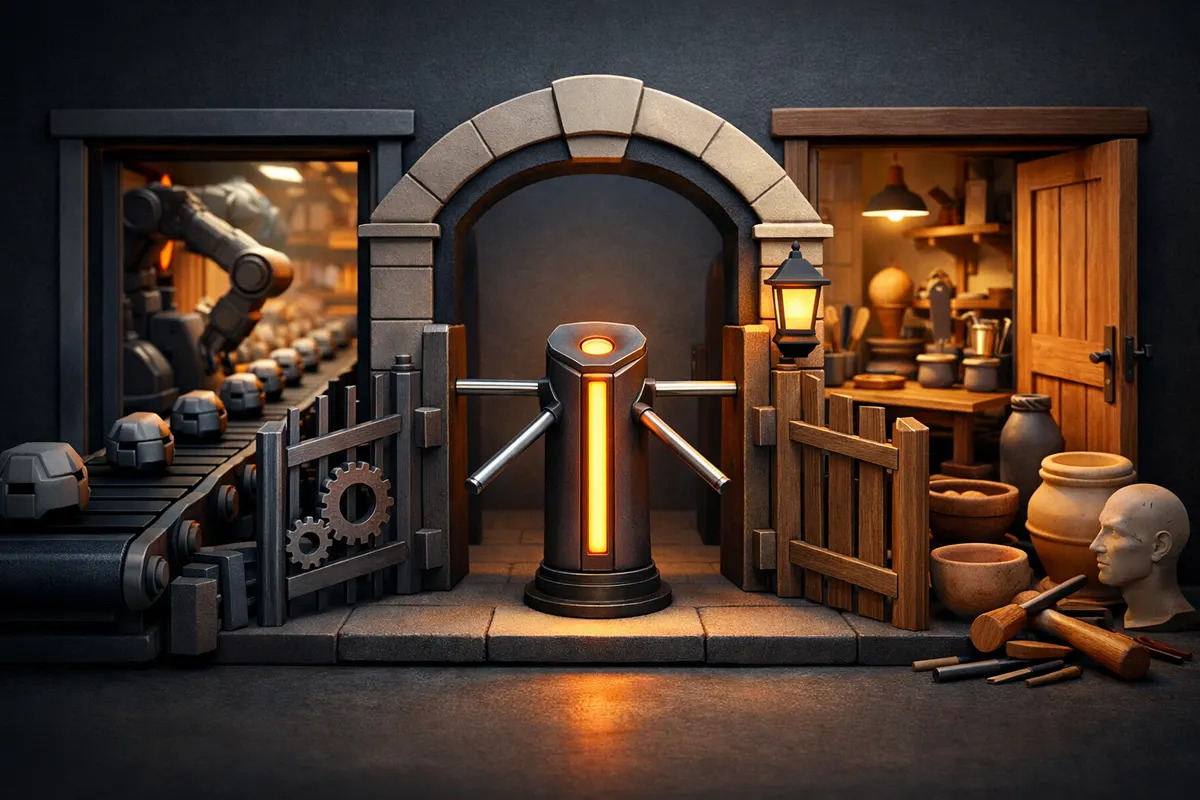
There's an image I keep coming back to: the factory versus the workshop. A factory stamps out identical units; a workshop makes things in which you can see the maker's path. A factory optimizes for speed; a workshop optimizes for precision of form and the growth of the person making it. A factory hides its process; a workshop can show you exactly how something was made.
I want my own system to be a workshop. Yes, there are coding agents, a knowledge base acting as a CMS, a knowledge graph, publishing pipelines, autonomous agents, audio summaries. But all of it needs to function as an amplifier of personal craft — not as a conveyor belt for depersonalized content.
Craft Isn't About the Past
The moment you say "craft," it's easy to slide into romanticism: things used to be honest and handmade, now they're artificial and hollow. It's a pretty picture, and it's false. The past wasn't idyllic — manual labor was often brutal, poorly paid, and unjust. There's no literal reason to go back there.
The past is useful not as a model to copy but as a benchmark. Craft carries things that still matter today: sustained attention, a skill that keeps growing, the connection between hand, eye, and mind, pride in the result, the ability to tell strong work from weak work. And all of that lives perfectly well not just at a workbench but in writing, in designing a knowledge base, in configuring a personal AI system, in producing content. Craft isn't measured by material — it's measured by your relationship to the work.
The Skill Gate
In agentic systems, people already talk a lot about "safety gates." That's fair: if an agent edits files, publishes articles, touches your knowledge base, your code repository, your server — it needs guardrails. You can't let a model freely rewrite reality.
But I'd add another gate next to it, and I'd call it the Skill Gate. A safety gate answers the question: will this agent break the system? A skill gate answers a different one: will this agent erode a human skill?
Before automating any process, I try to ask myself: what here is routine, and what is judgment? What skill grows while I do this by hand? Do I actually need that skill? Can I verify the agent's output? Could I still do this work myself if the agent vanished tomorrow?
For a company, that question is secondary — automation there exists for efficiency. But a personal project also exists to build your own system of thinking, and if automation destroys that, it's harmful even when it saves time.
What I Hand Off to Agents Without a Second Thought
There's a layer I'm happy to delegate almost always: transcribing audio, a first pass of text cleanup, finding repetitions and broken links, draft SEO fields, internal linking, compiling source lists, moving status flags, running publishing checklists. None of this is the core of the craft — it's what stands between me and the core. An agent won't do it perfectly, but it doesn't need to. When AI removes this layer, it gives me back time and attention for the work that actually matters.
What I Won't Hand Off Entirely
And there's a layer I can't fully delegate without losing the point: choosing the central question, articulating a position, connecting a topic to lived experience, deciding whether something is even worth publishing, the final structure and voice, ethical boundaries, the conclusion I'm willing to put my name on. This is where real, distinctive work is actually born — not in the fact that there are a lot of texts and each one took an hour to assemble. A living person has to stand behind the material — someone who understood something, tested it, applied it, and can explain it to others. Strip this layer out, and what's left is tidy AI-generated content, and soon there will be an infinite supply of that.
Dead Weight vs. Work That Gives You Hope
I like a simple distinction. There's dead-weight work: shuffling data, manually hunting for obvious duplicates, fixing formatting, rebuilding the same structure from scratch every time. It's exhausting and develops almost nothing. It should go.
And there's work that gives you hope: formulating a thought, finding your own position, spotting the connection between topics, realizing where you were wrong, turning a mess of notes into a clear piece of writing, changing your mind, building a method. After doing that kind of work, I come out sharper. You can make it easier and sharper with tools, you can bring in an agent as a critic — but if you remove it from the process entirely, development disappears along with it.
Tracking the Human Layer
I picture my content database gaining a field that tracks not just the topic and status of a piece, but the human contribution behind it: the main authorial input, what was handed to agents, which skill I deliberately kept by hand, the date of the final human edit, who signed off on the piece.
This isn't bureaucracy. It's a way of seeing what's left of the human core in a piece of writing. If that field stays empty across everything, the system has quietly started producing content without an author. If it's alive, it means AI is doing its job correctly — not replacing me, but working around me.
Servant, Tool, or Mirror
AI can be used in three different ways. As a servant: do it for me, think for me, decide for me. The most tempting mode, and the most dangerous one. As a tool: help me do faster what I already understand how to do, remove the routine, offer options. Already better. And as a mirror and training partner: show me where my thinking is weak, find the contradiction, ask about what I'm avoiding, compare my position against the sources.
That third mode is, to me, the future — because it doesn't just speed up production, it grows the author.
The Real Risk, and the Takeaway
I don't think the biggest risk of the AI era is that it will replace humans at every task — that's too blunt a way to put it. The real risk is subtler: a person gradually stops noticing which tasks actually mattered for them personally to do. You don't lose your job in a single day. You lose the skill, then the taste, then the judgment, then the connection to the outcome. What's left is someone who knows how to hand out assignments but can no longer tell strong work from weak work.
So the question of automation has long since stopped being purely technical for me. It's a human question: what do I need to keep doing myself in order to remain the author of my own work?
The principle I try to build around is simple: not everything that can be automated should be automated. Remove the routine, amplify the thinking, protect authorship, grow the skill. A good AI system doesn't turn you into a passive client ordering up results — it makes you a stronger author of your own work. And if this gets done right, the real story isn't that AI does everything for us — it's that AI helps us reclaim room for the work that actually matters.