

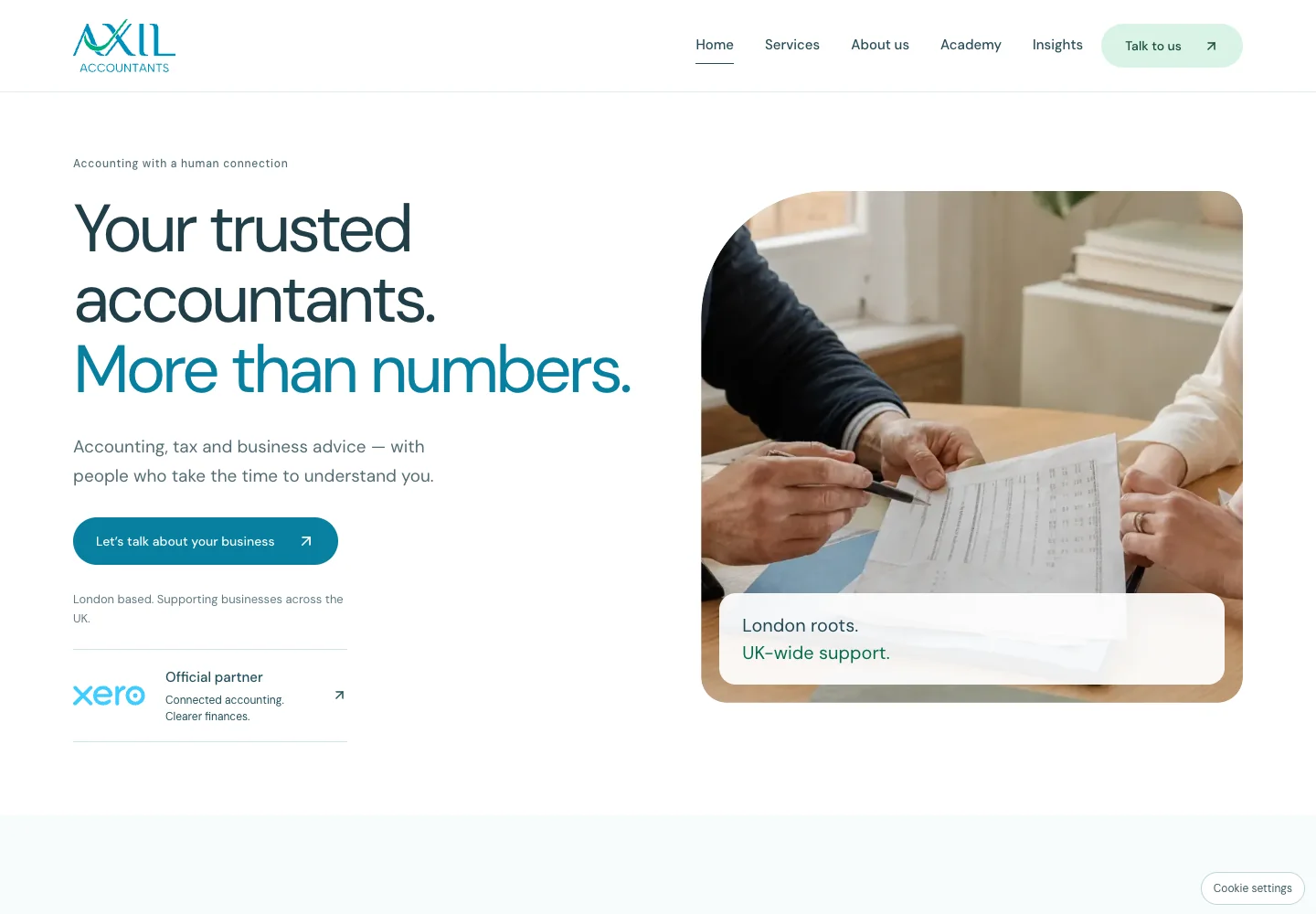
A website for an accounting business has several jobs. It must explain the services, make the people behind the practice credible and help a prospective client take an appropriate next step. When the business also offers training, it needs to serve learners without confusing them with people looking for an accountant.
AImpress built the website for Axil Accountants, a London-based practice supporting businesses across the UK. The project brings accounting services and the AXIL Accounting Academy into one experience. CRM integrations, analytics and dashboards form part of the wider business solution.
This case study focuses on the technology and the decisions behind the customer experience. The choice of a particular CRM or reporting product is secondary to what the business needs the connected system to do.
The challenge: two audiences, clear next steps
Someone who needs business accounting support arrives with different questions from someone considering a payroll course. The first visitor wants to understand the services, the team and how to start a conversation. The second needs to compare learning options, formats and levels of support.
The website gives each audience a clear route. Services, About, Academy and Insights have distinct places in the navigation. Contact options remain easy to find. The homepage introduces the practice before inviting visitors to explore its expertise and education offer.
The result is a shared identity with separate customer journeys. That structure also gives future content a natural home: a new service belongs with services, while a new course belongs in the Academy.
A modern website with a structured content foundation
The application uses Next.js and React for the public interface, with TypeScript supporting the implementation. Payload CMS and PostgreSQL provide the content and data foundation.
These technologies have practical roles. React makes shared interface elements consistent across pages. Next.js supports page delivery and routing. A structured CMS gives content a defined shape, while PostgreSQL stores records in a relational database. Together they provide a foundation that can evolve as the business adds services and content.
Content ownership does not mean that every part of a website must be freely editable. Some layouts and content are deliberately managed in code. Editing permissions and the handover of CMS access should match the team's responsibilities and the agreed scope.
Bringing the Accounting Academy into the website
The Academy sits alongside the accounting practice, with its own course information and package selection. Visitors can distinguish recorded courses from the practical career programme and understand the available support before enquiring.
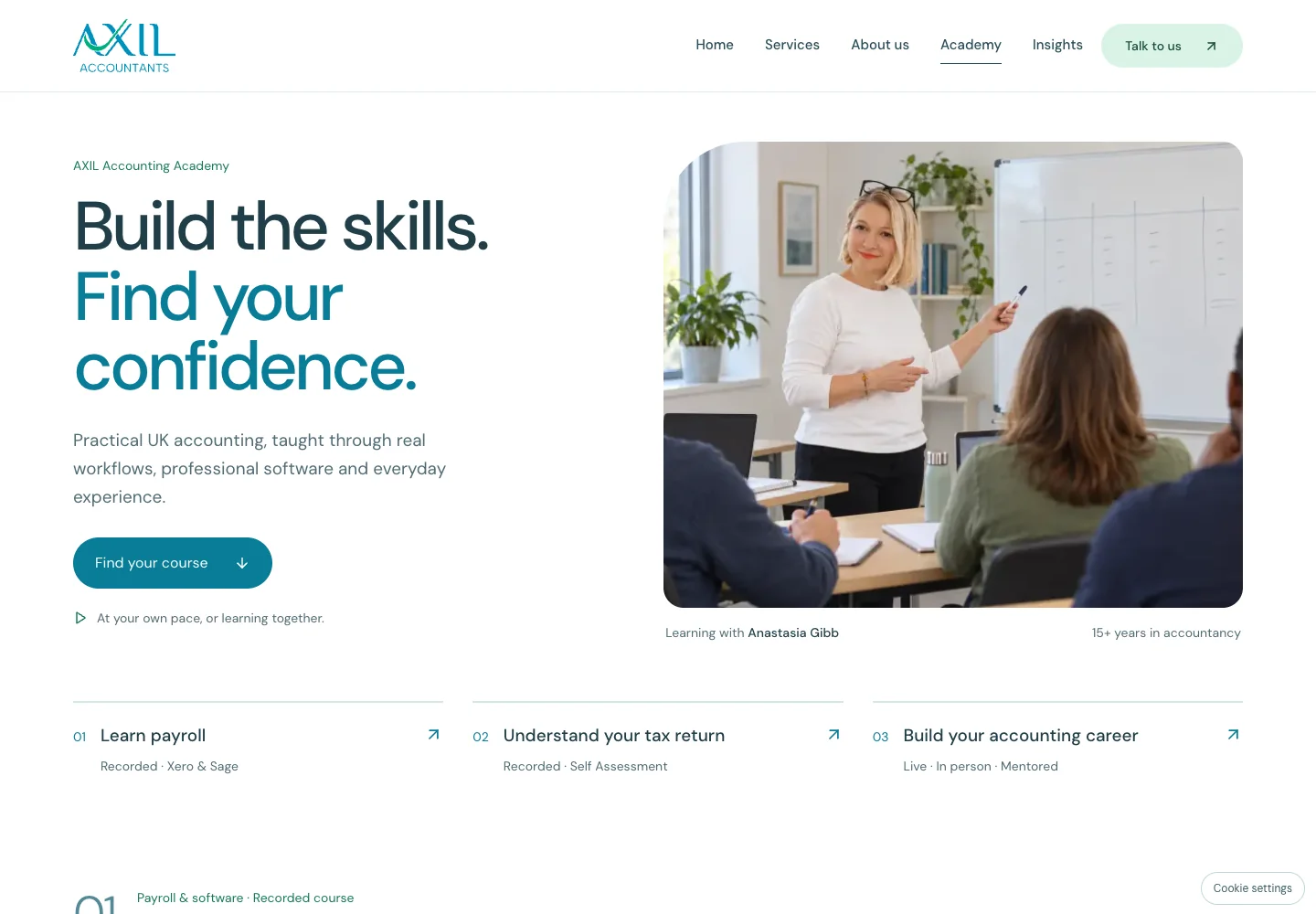
At launch, the public contact journeys use email and WhatsApp. Course package links provide context for the enquiry. The site does not present selecting a package as a completed purchase or automatic enrolment. Keeping that distinction clear helps the visitor understand what happens next.
The broader lesson for professional services is to organise different offers around the visitor's decision. A course, an advisory service and an ongoing accounting engagement should not all lead through an indistinguishable generic journey.
Connecting the website with the business
The wider delivery includes CRM integrations, analytics and dashboards. These are separate capabilities with different purposes: a CRM supports relationship management, analytics describes activity and a dashboard brings selected information into a useful view.
For a connected website, the questions to resolve are straightforward. What information should reach the team? Which system owns the client record? What identifies a new enquiry? Which event is just an expression of interest, and which confirms a business outcome?
An email or WhatsApp click indicates contact intent; it does not by itself prove that an enquiry was received or a new client was won. Useful reporting keeps those stages separate. Connecting systems should preserve that meaning instead of turning every click into a reported conversion.
APIs and webhooks make the solution adaptable
AImpress can connect a website to different CRM, communication and reporting tools through the APIs, webhooks and connectors those tools provide. An API allows one system to request or update data. A webhook lets a system notify another when an event occurs.
For a similar accounting business, the implementation begins with the process and available integration interfaces. Field mapping, access permissions and failure handling are then defined around that process. A change in software supplier should not require rethinking the entire customer journey.
Read our practical guide to website and CRM integration for accountants for the questions to settle before connecting a site to a practice's tools.
What the project delivers
Axil now has a live website that presents the practice, its services, its people and its Academy in a coherent structure. The technology foundation supports continued development, while the connected business capabilities extend the work beyond the public pages.
The public pages and business integrations give Axil a foundation for developing its services and education offer together. Future improvements can be prioritised using the customer journeys and operational information the team needs.
Explore the live Axil website, see our client projects, or read about AImpress website development and integration services.
Planning a website for a professional services business? Discuss your project. Tell us about the services you offer, the tools you use and what should happen after a prospective client gets in touch.