

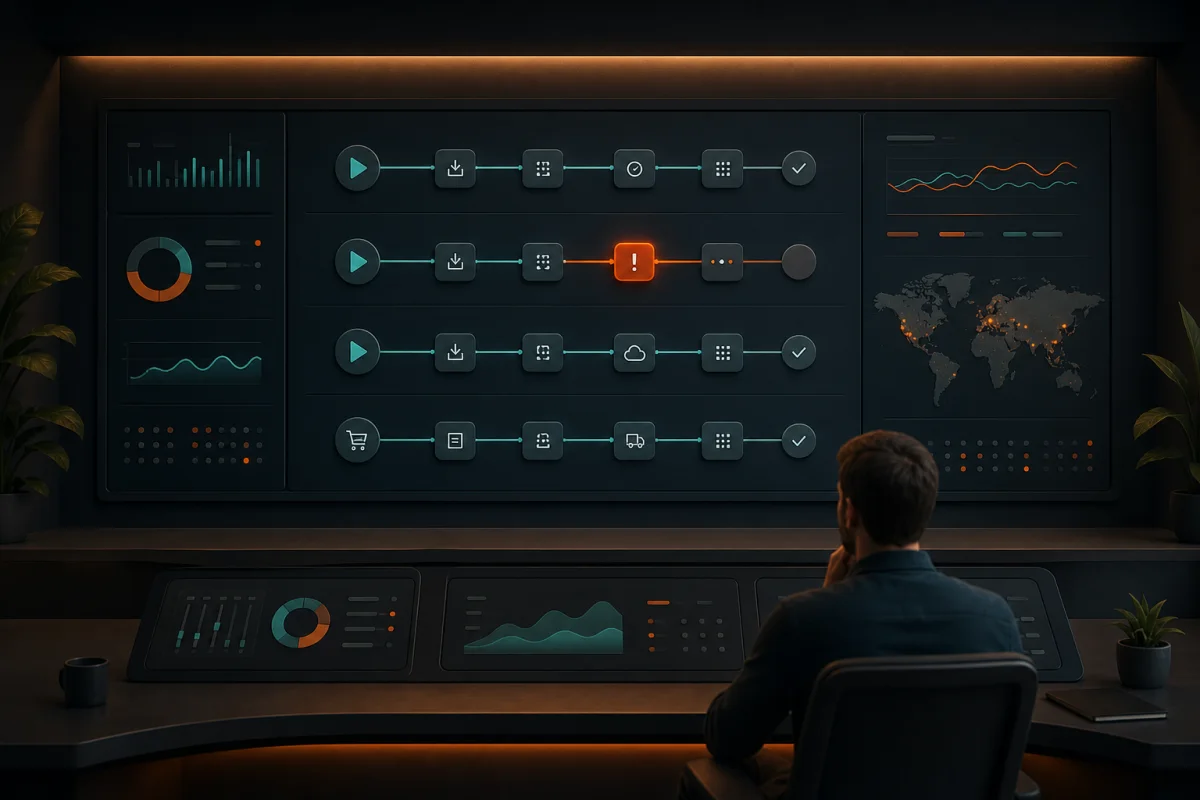
A green workflow execution does not necessarily mean the business outcome occurred. A request may return successfully while containing an application error, or a later database update may fail after an external action completed. Monitoring must follow business state as well as technical execution.
Track the expected rhythm
Know how often the workflow should run and how many records it normally processes. Alert when a scheduled process has not completed within its expected window. Zero failures are not reassuring if the trigger itself stopped firing.
Use structured context
Logs should include a correlation ID, business record ID, stage and outcome without exposing unnecessary personal data or secrets. This lets an operator trace one case across several systems.
Alert on actionable conditions
An alert should explain what failed, what already succeeded and whether repeating the action is safe. Separate transient supplier errors from data that requires human correction. Route alerts to a named owner and define response expectations for critical processes.
Record durable state
For multi-step workflows, store stages such as preparing, awaiting approval, publishing and completed. Record external identifiers and URLs immediately after successful writes. Durable state allows recovery without replaying completed actions.
Review trends
Monitor execution volume, error rate, retries, queue age and manual correction. Gradual increases often reveal an API change or deteriorating input quality before a complete outage occurs.
Test recovery
Deliberately simulate unavailable APIs, invalid credentials and timeouts in a safe environment. Confirm that operators receive useful information and that rerunning does not create duplicates.
Monitoring is part of the product, not an optional dashboard. A workflow becomes trustworthy when the business can detect uncertainty and recover without guessing.